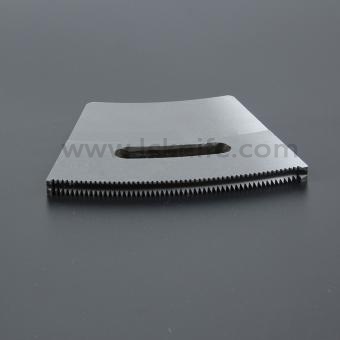
How Maanshan Licheng Knife Delivers Reliable, Cost-Effective Cutting Performance
At a Glance
For many room-temperature guillotine shearing applications, 9CrSi tool steel offers a practical balance of hardenability, cutting-edge hardness, grindability and material cost. Its performance, however, depends on sound material selection and carefully controlled manufacturing and heat-treatment processes.
|
Typical hardness
|
Main strengths
|
Common workpieces
|
Key success factor
|
|
HRC 58–61
|
Hardenability
& grindability
|
Carbon steel,
aluminium, copper
|
Controlled
processing
|
1. Understanding Shear Blade Material Options
Industrial shear blades are produced from different tool-steel families to meet varying requirements for wear resistance, impact toughness, operating temperature and service life. The most suitable grade depends on the material being cut, sheet thickness, machine condition and production volume.
|
Material family
|
Examples
|
Carbon content
(as stated)
|
Typical
characteristics
|
|
High-carbon, high-chromium cold-work steels
|
Cr12MoV, D2, SKD11
|
1.40%–1.60%
|
High wear resistance; suitable for high-volume cutting
with relatively low impact.
|
|
Tough, impact-resistant tool steels
|
H11, H13, 6CrW2Si
|
0.35%–0.60%
|
Balance of hardness and toughness; good thermal-fatigue
resistance and tempering stability.
|
|
High-speed and powder-metallurgy steels
|
W6Mo5Cr4V2, W18, ASP series
|
0.70%–1.30%
|
High hot hardness and wear resistance for demanding
high-speed or elevated-temperature conditions.
|
2. Why 9CrSi Is a Practical Choice for Many Guillotine Shears
9CrSi is a low-alloy tool steel listed under Chinese standard GB/T 1299. It is known for its hardenability, high hardness after quenching and useful tempering stability. For common room-temperature shearing of ordinary carbon-steel sheets and structural sections, it can provide a balanced combination of cutting performance and cost.
|
Element
|
Content range
(wt.%)
|
|
C
|
0.85–0.95
|
|
Si
|
1.20–1.60
|
|
Mn
|
0.30–0.60
|
|
Cr
|
0.95–1.25
|
|
P
|
≤ 0.030
|
|
S
|
≤ 0.030
|
Key Performance Advantages
Good hardenability. Silicon and chromium improve hardenability compared with plain-carbon tool steels such as T10. With an appropriate process, larger cross-sections can achieve a more uniform hardness profile. At the same time, it has lower sensitivity to overheating, resulting in less deformation during quenching, making it highly suitable for slender parts and thin-edged shearing machine cutting tools. Meanwhile, the quenching process window for H13 and other heat-resistant steels is more stringent, and the cost of large-scale rework is higher.
Balanced cutting-edge hardness. The carbon content of approximately 0.9% of 9CrSi gives the base material sufficient hardness for shearing. After normalizing, quenching, and tempering, its hardness typically reaches HRC 58-61, providing a balanced cutting-edge sharpness and wear resistance that are far superior to H13, and it is also softer and less brittle than the high-carbon, high-chromium steel Cr12MoV, so it is less prone to chipping during shearing.
Machinability and grindability. In the annealed condition, 9CrSi can be machined more readily. Its carbide structure can also support precision grinding to produce a clean, accurate cutting edge. However grinding high-alloy mold steel is difficult and increases the risk of thermal burns and material deformation.
Cost efficiency. Compared with highly alloyed and high-speed steels, 9CrSi uses fewer expensive alloying elements and is commonly available in standard bar and flat-steel sizes. That can help shorten the knife production time a lot.
3. Manufacturing and Heat-Treatment Process
Material grade alone does not determine blade life. Forging quality, annealing, quenching, tempering and final grinding all influence dimensional stability, microstructure and cutting performance. The process figures below are those provided in the source article; they are not a substitute for a qualified, grade-specific process specification.
|
Process stage
|
Parameters
stated in source
|
Purpose /
process note
|
|
Preheating
|
850–950°C
|
Promote temperature uniformity before hot working.
|
|
Forging
|
1,050–1,150°C; finish at 800–850°C
|
Avoid overheating; repeated upsetting and drawing may
help improve structural uniformity.
|
|
Spheroidizing annealing
|
780–800°C, hold 2–4 h; furnace cool to 500°C.
Alternative cycle: 700–720°C, hold 4–6 h.
|
Improve machinability; source reports 197–241 HB after
annealing.
|
|
Stress-relief annealing
|
650–700°C, hold 2–4 h, then air cool
|
Reduce residual stresses in complex workpieces.
|
|
Oil quenching
|
820–860°C
|
Control austenitizing and cooling to limit grain growth
and cracking.
|
|
Salt-bath isothermal quenching (alternative)
|
850–870°C, then nitrate salt bath at 160–180°C
|
An alternative described for precision tools;
suitability requires process validation.
|
|
Low-temperature tempering
|
150–250°C, typically 1–2 h
|
Relieve quenching stresses while retaining higher
hardness; source reports approx. 60–62 HRC.
|
|
Medium-temperature tempering
|
300–400°C
|
Approx.
55–60 HRC with improved impact resistance.
|
|
Final grinding / coating
|
CBN or diamond grinding; optional TiN coating
|
Support dimensional accuracy, surface quality and,
where specified, surface wear resistance.
|
Important process-safety and engineering note: The text mentions asbestos ash for post-forging insulation. Asbestos-containing materials should not be used; select a compliant, non-asbestos insulating medium and follow local occupational-safety requirements. Actual process temperatures, holding times and cooling media must be confirmed by a qualified metallurgist for the specific blade size, furnace and target properties.
4. Typical Applications
Carbon-steel sheets and thin plates. Commonly used for cutting, leveling and trimming Q235 carbon steel, thin cold-rolled sheets and hot-rolled sheets.
Non-ferrous metals. Suitable for relatively soft materials such as aluminium and copper sheets where a clean cut and controlled burr formation are important.
Light industry and building materials. Applications include steel structures, colour-coated roofing-sheet lines and ventilation-duct manufacturing.
9CrSi is generally positioned for room-temperature shearing of low- to medium-strength materials. Blade geometry, clearance, machine rigidity and the actual material condition remain important selection factors.

5.Typical Customer Case Studies
Case Study 1: A Steel Structure and Color-Coated Roofing Sheet Manufacturer
High-Frequency Shearing of Thin Metal Sheets
Operating Conditions:
The customer operates CNC guillotine shearing machines that frequently cut Q235 carbon steel sheets and color-coated steel sheets with thicknesses ranging from 1 mm to 6 mm. Production volumes are high, making blade replacement frequency and tooling costs important considerations.
Material Selection:
The customer initially tried imported Cr12MoV blades, which offered good wear resistance but occasionally experienced minor edge chipping due to impact loads.
The customer subsequently switched to specially manufactured 9CrSi guillotine shear blades, heat-treated to HRC 60.
Results and Benefits:
The 9CrSi blades maintained sufficient cutting-edge sharpness, delivering smooth, clean cuts with minimal burr formation. Thanks to their good toughness, the blades no longer experienced edge-chipping failures.
Overall, the cost-effectiveness, measured by the cost per cut, improved significantly, with total cutting costs reduced by nearly 30% compared with high-alloy steel blades.
Case Study 2: A Plastic Profiles and Sheet Recycling & Processing Company
Applications Involving Combined Operating Conditions
Operating Conditions:
The customer needed to cut and shred industrial plastic sheets, including PET and HDPE, with thicknesses ranging from 1 mm to 10 mm, as well as certain lightweight aluminum profiles. The materials required precise length cutting and subsequent size reduction.
Material Selection:
The customer selected 9CrSi shear blades that had undergone a specialized cryogenic treatment process.
Results and Benefits:
The 9CrSi blades provided the sharp cutting edges required for plastic shearing while also withstanding the impact caused by hard particles in the plastic or minor material contaminants.
The average blade regrinding interval met the customer's expected requirements, helping maintain continuous and stable production.
6. Common Failure Risks in 9CrSi Blades
Although 9CrSi is widely used for shear and cutting tools, blades can fail prematurely when material quality, heat treatment, blade geometry or operating conditions are not properly controlled. Here are three key risks:
Thermal or structural deformation under high-stress cutting conditions.
Brittle fracture, which can create safety risks and unplanned production stoppages.
Uneven carbide distribution, which may contribute to non-uniform wear along the cutting edge.
7. Maanshan Licheng's Process-Optimization Approach
Maanshan Licheng Blade Manufacturing has carried out process research to improve the forging, annealing, quenching and tempering workflow for 9CrSi blades.
Controlled austenitization. Adjusting the heating process to promote appropriate dissolution of alloying elements into the austenite matrix.
More uniform carbide distribution. Managing thermal processing to improve the distribution of carbides through the steel matrix.
A balanced property profile. Targeting a combination of edge wear resistance, tempering resistance and impact toughness.
These process improvements are intended to extend blade service life, reduce replacement frequency and support more productive workshop operation.
8. Your Shear Blade Manufacturing Partner
Maanshan Licheng Blade Manufacturing integrates product development, manufacturing and sales. In addition to 9CrSi bar-cutting and guillotine shear blade solutions, the company states that it supplies wear-resistant industrial shear blades for steel metallurgy, metal processing, machinery manufacturing and automotive-component production.
We focus on precision-engineered blades designed around the material being cut, machine configuration and production requirements. Work with Maanshan Licheng to identify a practical blade solution for dependable cutting performance and operating efficiency.


 IPv6 지원 네트워크